
Databricks held its annual Data + AI Summit from June 15 to 18, 2026, at the Moscone Center in San Francisco. More than 30,000 data and AI professionals attended in person from 150 countries, with tens of thousands more joining virtually, making it the largest data and AI conference in the world. Jay Bhinde (Founder and CEO) represented from Zilbix. The opening keynote, delivered by co-founder and CEO Ali Ghodsiset the frame for everything that followed: AI does not have an intelligence problem. It has a context problem.
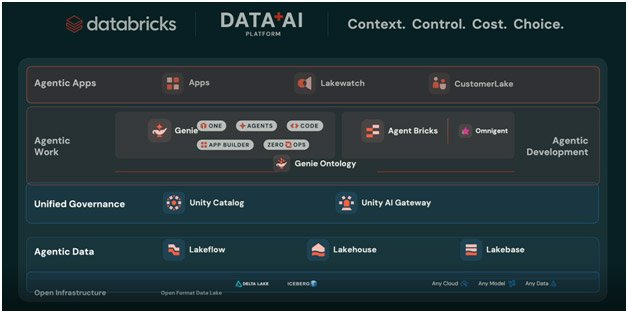
Ghodsi organized the platform agenda around four challenges enterprises face when scaling AI: Context, Control, Cost, and Choice. Every major announcement across four days traced back to one or more of those four. Taken together, the announcements describe a unified platform for the agentic era built across four architectural layers: an Agentic Data Layer, a Unified Governance Layer, an Agentic Work Layer, and Agentic Applications.
Here are the most significant takeaways for enterprise leaders.
The Central Argument: AI Has a Context Problem, Not an Intelligence Problem
Ghodsi opened with a provocation where he argued that AI hasreached a level of general intelligence that would have seemed remarkable just a few years ago. The limiting factor is not what AI can reason. It is what AI can access. Business context is scattered across dashboards, pipelines, Slack threads, CRM records, and ticketing systems. When AI cannot find that context, it fills the gap with inference, producing generic or wrong answers. That observation drove the entire product agenda.
To solve it, Databricks built what it calls Genie Ontology: a live context layer that runs continuously in the background, building a knowledge graph of how a company works, what its data means, and which definitions carry organizational authority. Rather than sending agents on a live data traversal every time a question arrives, Genie Ontology extracts business knowledge from tables, queries, dashboards, pipelines, and connected workplace apps, and organizes it into a continuously updated graph. It uses an algorithm called OntoRank, conceptually similar to Google’s PageRank but designed for enterprise data assets, weighing definitions by source authority, usage frequency, and ties to certified assets. Databricks reported internally that Genie Ontology improved query accuracy to 84.5% on a benchmark of real-world enterprise data questions, compared to 52.4% for the strongest general-purpose coding agent on the same test. It also ran at twice the speed.
Genie Ontology feeds directly into Unity Catalog’s new semantic capabilities including Business Glossary, Domains, and Metrics, meaning the investment organizations make in defining business terms compounds across every agent, dashboard, and report that draws on that shared context layer.
The Agentic Data Layer: Lakeflow, Lakehouse, and Lakebase
The foundation of the platform rests on three data capabilities that together eliminate the architectural fragmentation that has limited enterprise AI deployments.
LakeFlow, Databricks’ data ingestion and pipeline service, now connects to more than 100 enterprise systems including Salesforce, Workday, NetSuite, and Google Analytics. Three capabilities reached general availability simultaneously at the Summit, making it a production-ready ingestion layer for the full enterprise data estate.
Lakebase is Databricks’ database service, built directly on the same storage layer as the rest of the platform. New capabilities include the ability to create an instant copy of a production database for safe testing without touching live data, automatic recovery if a system goes down across regions or cloud providers, and built-in search that handles both keyword and AI-style queries natively.
The most significant announcement for enterprise data teams was Lake Transactional Analytical Processing (LTAP). For decades, enterprises have maintained two separate systems: one for live transactions (orders, payments, customer records) and one for analytics and reporting. Keeping them in sync required complex, expensive data pipelines that were slow and prone to failure. LTAP eliminates that entirely. Both workloads now run against the same single copy of data stored in the lakehouse. Each uses its own engine optimized for its purpose, but they share one governed, consistent data source. For AI agents that need to act on live business data and analyze historical patterns at the same time, this removes a long-standing architectural barrier.
Lakehouse//RT completes the data layer with a new real-time analytics capability announced at the Summit. For years, enterprises that needed fast query performance had no choice but to maintain a separate real-time serving system alongside the lakehouse, adding cost, data duplication, and governance complexity. Lakehouse//RT eliminates that entirely. It runs analytical queries directly against existing data in the lakehouse, delivering results in under 100 milliseconds at scale, with no data copies, no separate infrastructure, and no additional governance layer to manage.
Source: Databricks Data + AI Summit 2026
The Unified Governance Layer: Unity Catalog and Unity AI Gateway
Governance was one of the most substantive themes across the Summit, and it has matured significantly beyond catalog-level asset management.
Unity Catalog received three new semantic layer capabilities that work directly with Genie Ontology. Business Glossary lets teams define authoritative business terms and connect them to the underlying data assets. Domains organize the catalog into business-aligned areas so agents and users receive scoped, relevant context rather than the entire catalog at once. Metrics turns KPIs into governed, reusable objects callable from dashboards, agents, and applications without being redefined each time.
Unity AI Gatewayextends governance from the catalog to the runtime. It provides a single entry point for all agent and model traffic across an organization, with spend caps at group and individual level, smart routing that directs simpler requests to lower-cost models while reserving premium models for complex workloads, cross-provider failover across OpenAI, Anthropic, and Google Gemini on AWS, Azure, and Google Cloud Platform, contextual security policies, and end-to-end agent trace capture via MLflow for forensic investigation when agents produce unexpected results. For enterprise leaders in Financial Services, Healthcare, and Insurance, the audit trail and runtime policy enforcement capabilities are the most immediately relevant elements.
The Agentic Work Layer: Genie and Agent Bricks
The Genie suite received the most expansive set of updates at the Summit. Genie Oneis Databricks’ agentic AI coworker for business teams. It connects to more than 50 enterprise applications including Salesforce, Google Drive, SharePoint, Jira, and the full Databricks lakehouse, and takes action across them rather than simply retrieving information. It is available on web, iOS, and Android with scheduling, alerts, and MCP tool integrations built in.
The full Genie suite now spans five capabilities. Genie One serves business users across marketing, finance, and sales. Genie Agents lets any user turn a Genie conversation into a reusable, shareable agent accessible in Slack, Teams, or any connected surface without engineering involvement. Genie Codehandles data engineering and SQL work in an expanded full-page workspace designed for longer-running multi-step tasks. Genie App Builder generates working web applications from plain-language descriptions, backed by lakehouse data and governed by the same Unity Catalog access controls that apply across the platform. Genie ZeroOps, in private preview, is an autonomous background agent that continuously monitors pipelines and data assets, investigates anomalies, tests proposed fixes in an isolated Lakebase branch, and presents remediation recommendations for human approval. Nothing touches production without explicit sign-off.
Agent Bricks, Databricks’ developer platform for building production AI agents, now supports every major agent framework including LangGraph, CrewAI, the Claude Code SDK, and OpenAI Agent SDKs, with secure execution sandboxes, built-in document AI, and a new meta-orchestration layer called Omnigent. Omnigentsits above existing agent frameworks and provides a common layer for composing agents across frameworks, with centralized security, policy, and cost controls.
Agentic Applications: Apps, CustomerLake, and Lakewatch
Three application-layer announcements round out the platform picture.
Databricks Apps, combined with the new App Spaces governance boundary and Serverless Micro Apps that scale to zero when idle, makes it practical to deploy governed applications across an organization without reserved-capacity infrastructure costs.
CustomerLake is a new customer data platform built directly inside the Azure Databricks lakehouse. Rather than maintaining a separate CDP alongside the data platform, CustomerLake uses Profile Agents and Campaign Agents to assemble Customer 360 profiles and run personalized campaigns from the same governed lakehouse foundation organizations already use for analytics and AI.
Lakewatch, introduced alongside the acquisition of Panther, is an agentic security information and event management service that brings autonomous threat detection and response into the lakehouse stack.
What This Means for Enterprise AI Strategy
The Summit reinforced a point Zilbix has been making with clients consistently: before enterprises can capture value from agentic AI, they need to get their data right. The platforms are maturing rapidly. The constraint is no longer what AI can do, it is whether enterprise data foundations are structured, governed, and connected enough to support agents acting on accurate, real-time information across core business workflows.
The Databricks product agenda at this Summit addressed the four most persistent barriers to AI ready data at enterprise scale. Context gaps, through Genie Ontology and the semantic layer in Unity Catalog. Runaway costs, through Unity AI Gateway spend controls and smart routing. Governance gaps, through runtime policy enforcement and end-to-end audit trails. And architectural fragmentation, through LTAP and Lakehouse//RT. Organizations that address these barriers structurallyare the ones that will be ready to deploy agents that actually work.
As a Databricks partner, Zilbix is positioned to help enterprise leaders navigate the full scope of the platform and build the AI and data foundations required to compete in the agentic era. Combined with our broader ecosystem of technology partnerships spanning Google Cloud, Dataiku, ElevenLabs, Zapier, Collibra, and AWS, Zilbix is committed to helping clients build future ready enterprises.
To explore how Zilbix can help your organization prepare for agentic AI, schedule a consultation or reach out at contact@zilbix.com.
About Zilbix
Zilbix is a premier management consulting firm specializing in Business, Artificial Intelligence (AI), and Digital Transformation. Zilbix partners with senior leaders across Fortune 500 corporations, Private Equity backed companies, Emerging Enterprises, and Public Sector organizations to drive complex initiatives from strategy through execution. By combining the agility of a boutique firm with the rigor of global consulting methodologies, Zilbix enables enterprises to accelerate growth, optimize costs, and harness the power of advanced AI to build future ready businesses.
For more insights on AI strategy, enterprise transformation, and the future of agentic AI, follow Zilbix on LinkedIn.
