
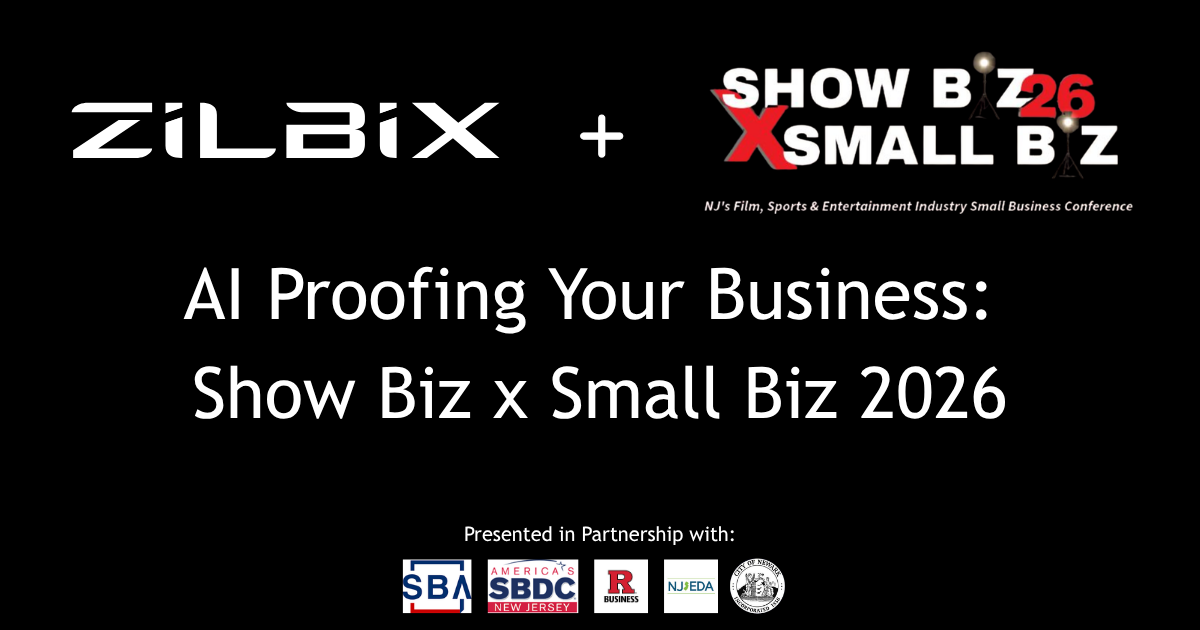
On June 11, 2026, Jay Bhinde (Founder and CEO) joined fellow panelists at Show Biz x Small Biz 2026, New Jersey’s Film, Sports and Entertainment Industry Small Business Conference, hosted at Rutgers University in Newark, New Jersey. The session, moderated by Dr. Jackeline Mejias-Fuertes, focused on one of the most pressing questions facing business owners today: how do you AI-proof your business before AI disrupts it?
The audience was made up of small business owners, entrepreneurs, suppliers, and service providers looking to participate in and grow within New Jersey’s expanding film, sports, media, and entertainment sectors. The insights from the panel, however, apply well beyond any single industry. They are relevant to any small or mid-market business owner navigating an economy being reshaped by AI.
Here are the key takeaways from the discussion.
What AI Proofing Your Business Actually Means
AI proofing means getting ahead of disruption rather than reacting to it. The businesses that take the time to understand where AI will reshape their model, before it happens, will have a meaningful head start on the ones that wait.
Every business has two types of functions: those where AI can automate, accelerate, or replace human effort entirely, and those where human judgment, relationships, and creativity remain essential. The businesses that will thrive are the ones that deliberately map their operating model against both categories. Where AI can take over, let it. Where human touch is the competitive advantage, protect and invest in it.
For small and mid-scale businesses, this means asking a straightforward set of questions. Which parts of your business model are most vulnerable to AI-driven alternatives?
Which parts of your client relationships are built on trust and creativity that no AI can replicate?
Where can AI make you significantly more productive without compromising what makes your business valuable?
The businesses that answer those questions proactively will have a meaningful edge against their competitors.
The Cost of Doing Business Is Going Down. That Is Good News for Small Businesses.
One of the most underappreciated shifts AI is driving is a significant reduction in the cost of running a business. Tasks that previously required outsourcing to specialized providers such as content writing, marketing, prototype development, initial product buildscan now be done in-house at a fraction of the cost and time.
For small businesses, this is one of the most meaningful near-term opportunities AI presents. The playing field between large organizations with significant resources and leaner businesses is compressing. A small production company, a sports marketing firm, or an entertainment services supplier can now produce marketing content, develop MVPs, build client proposals, and manage communications at a quality and speed that previously required teams several times their size.
The operational barrier to competing with larger players is lower than it has ever been. The businesses that recognize this and move quickly will capture opportunities that would have been out of reach two or three years ago.
Upskilling Is Not Optional
AI is changing how content is created, distributed, and consumed across every sector. For entrepreneurs in film, sports, media, and entertainment, the opportunities this creates are significant. But capturing them requires understanding the tools well enough to use them intelligently.
The most important thing business owners can do right now is get hands-on with AI. Not just at the staff level but at the leadership level. C-suite executives and business owners who do not develop their own working understanding of AI are taking a real risk. The decisions about where to invest, which tools to adopt, and how to integrate AI into the business require judgment that comes from direct engagement.
Human in the loop remains essential. AI can generate content, surface insights, and accelerate workflows, but the judgment, authenticity, and trust that clients and audiences expect from a business still comes from people. The goal is not to replace that human layer. It is to make it more effective by removing the lower-value work that surrounds it.
The Biggest Mistakes Businesses Make When Adopting AI
The panel discussion surfaced several common pitfalls that businesses encounter when they move too quickly or without sufficient preparation.
The most fundamental is data quality. AI is only as good as the data it works with. Businesses that try to implement AI before they have clean, organized, and reliable data will get unreliable outputs and draw incorrect conclusions. Getting data right is the foundation that everything else builds on.
The second is failing to think through which processes should be automated and which should not. Automation without judgment creates new risks. Not every business process benefits from removing the human element, and in industries built on creativity, relationships, and trust, the cost of getting that wrong is high.
Data security, intellectual property, and privacy considerations also deserve serious attention. Small businesses that use AI tools without understanding how those tools handle proprietary content, client data, and sensitive information are taking on risks they may not be aware of.
The Trend to Watch: Agentic AI
Agentic AI refers to AI systems that do not just respond to prompts but take autonomous action across multi-step workflows. Rather than waiting for a human to initiate each task, an agent perceives a goal, selects tools, executes a sequence of actions, and adapts based on outcomes. For small businesses, the practical implication is significant: agentic AI will allow lean teams to automate not just individual tasks but entire workflows, from client outreach and proposal generation to project coordination and reporting.
The businesses that begin experimenting with agentic AI now will have a meaningful advantage as the technology matures and the cost of deploying it continues to fall.
The One Piece of Advice for Business Owners
The closing question asked for a single piece of advice for entrepreneurs looking to future-proof their businesses in an AI-driven economy.
Get hands-on with AI. Do not delegate your AI learning entirely to your team. As a business owner, the more directly you engage with AI tools, understand what they can and cannot do, and experiment with how they apply to your specific business, the better your decisions will be about where to invest, what to automate, and where to keep the human touch that makes your business distinctively yours.
AI is not coming for your business. But a competitor who understands it better than you do might be.
About Zilbix
Zilbix is a premier management consulting firm specializing in Business, Artificial Intelligence (AI), and Digital Transformation. Zilbix partners with senior leaders across Fortune 500 corporations, Private Equity backed companies, Emerging Enterprises, and Public Sector organizations to drive complex initiatives from strategy through execution. By combining the agility of a boutique firm with the rigor of global consulting methodologies, Zilbix enables enterprises to accelerate growth, optimize costs, and harness the power of advanced AI to build future ready businesses.
For more insights on AI strategy, enterprise transformation, and the future of agentic AI, follow Zilbix on LinkedIn.
